
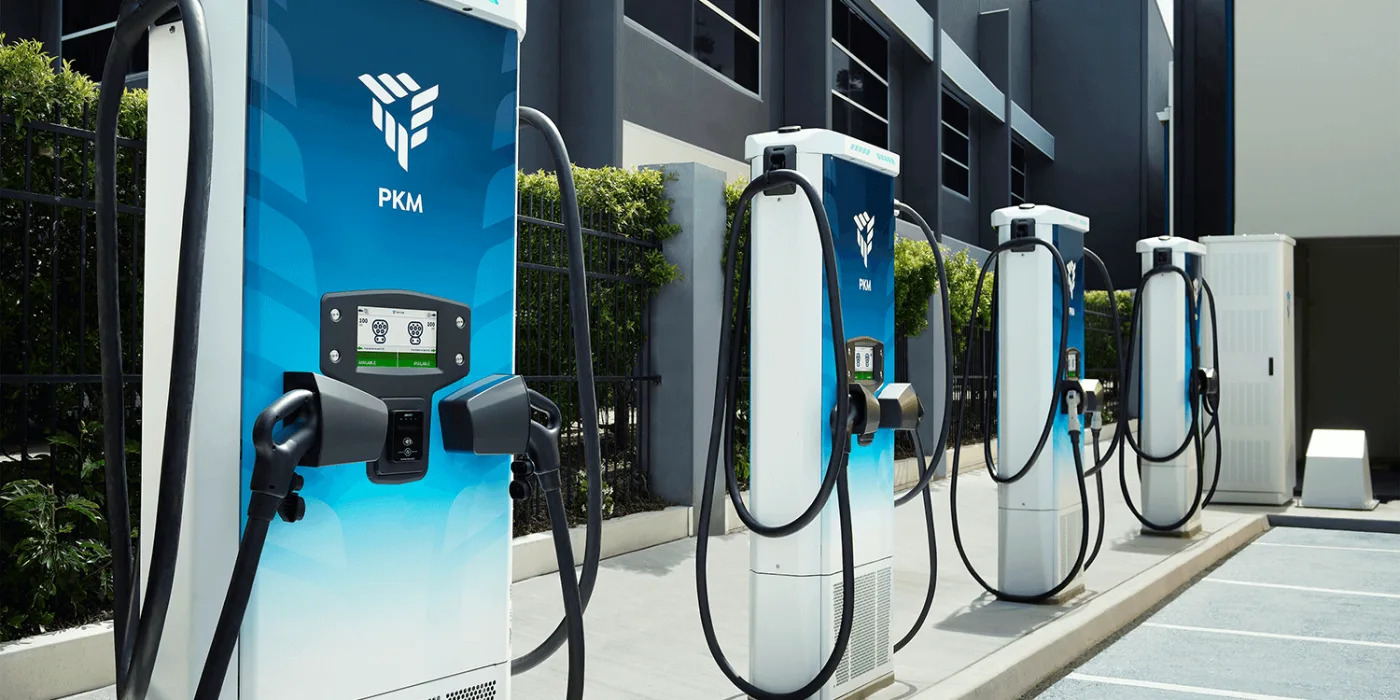
The OCPP protocol for EV chargers has become one of the most important foundations for modern electric vehicle charging networks. As the EV ecosystem expands, Charge Point Operators (CPOs) must make infrastructure decisions that support long-term scalability, interoperability, and system flexibility. Open standards like the Open Charge Point Protocol ensure chargers communicate seamlessly with backend platforms, reduce vendor lock-in, and enhance operational efficiency.
What Is OCPP? A Clear Definition for Modern Charging Networks
Definition and Purpose of OCPP
The Open Charge Point Protocol (OCPP) is a globally recognized communication standard that enables electric vehicle (EV) chargers to connect and communicate with backend management systems. Its purpose is to provide a universal language that allows different chargers, operators, and software platforms to work together seamlessly.
OCPP as the Universal EV Charger Communication Standard
As EV infrastructure continues to scale worldwide, standardization has become essential. OCPP fills this need by acting as the universal link between hardware and software.
Role of the Charger and Central System
In the OCPP ecosystem, the charger is the Charge Point, and the backend platform is the Central System. OCPP governs how they exchange information status reports, user authentication, charging commands, and diagnostics.
Understanding How OCPP Enables Interoperability for EV Chargers
What Interoperability Means in the EV Charging Ecosystem
Interoperability refers to the ability of EV chargers, management platforms, and third-party systems (payment processors, roaming networks, utilities, fleet platforms) to exchange data and operate harmoniously. In practice, this means a Nissan Leaf driver using a charger from Manufacturer A on a network powered by a software vendor from Manufacturer B, all without encountering compatibility issues.
Avoiding Vendor Lock-In Through Open Standards
Vendor lock-in occurs when a CPO relies on proprietary charger firmware or backend software, making future migrations expensive or technically impossible. OCPP breaks this dependency by providing a universal communication protocol.
Mixed Hardware Compatibility
OCPP makes it possible to run chargers from multiple vendors under a single management platform ideal for large, diverse charging networks that use different types of charging equipment.
Key Components of OCPP Communication
Charge Point ↔ Central System Roles
Charge Points act as data generators, continuously sending messages such as:
- Status Notification (available, charging, faulted)
- Meter Values (energy consumption and power levels)
- Heartbeat (regular connectivity checks)
- Boot Notification (identity and capabilities report)
The Central System responds with commands like:
- RemoteStartTransaction / RemoteStopTransaction
- Change Configuration
- Firmware Update
- SetChargingProfile
The clarity of these roles ensures reliability and minimizes communication errors.
WebSocket Communication Channel
OCPP uses a persistent WebSocket connection, enabling low-latency, bidirectional communication. Unlike traditional HTTP polling, WebSocket:
- Reduce latency significantly
- Improve efficiency by maintaining a constant open channel
- Support real-time diagnostics
- Ensure faster command execution, which is crucial in high-utilization sites
This technical design choice is one reason OCPP has become the industry standard for EV charger communications.
Boot Notification Sequence
When a charger first powers on, it initiates a Boot Notification message containing its identity (serial number, vendor, model, firmware version). The Central System responds with:
- Accepted / Pending / Rejected status
- Heartbeat interval
- Configuration parameters
A successful Boot Notification ensures the charger is registered and authorized to operate under the network.
Comparing OCPP 1.6 vs. OCPP 2.0.1: What CPOs Must Know
Differences Between 1.6 and 2.0.1
OCPP 1.6 (widely deployed) and 2.0.1 (modern standard) differ significantly. OCPP 2.0.1 includes:
- Enhanced security layers
- Detailed device and component-level monitoring
- Advanced smart charging logic
- Improved extensibility for emerging technologies
For CPOs scaling their networks, understanding these differences is key to futureproofing infrastructure.
Security Enhancements in 2.0.1
OCPP 2.0.1 addresses evolving cybersecurity threats with:
- Certificate-based authentication for charger identity
- Mutual TLS (mTLS) for encrypted communication
- Secure Firmware Update procedures
- Security Event Notifications for intrusion detection
- Logging and audit trails for forensic analysis
These improvements reduce the risk of unauthorized access, charging manipulation, and backend breaches.
Smart Charging Improvements
Operators can dynamically control load distribution, charging profiles, and energy optimization, which is especially valuable for retail charging environments.
Why CPOs Should Prioritize OCPP-Enabled Infrastructure
Lower Integration Costs
Open standards significantly reduce the need for custom engineering during charger onboarding, backend migration, or network upgrades. Because OCPP ensures consistent message formats, CPOs avoid:
- Proprietary protocol conversions
- Costly hardware-software pairing limitations
- Custom middleware development
This allows networks to scale faster while maintaining predictable costs.
Vendor Flexibility and Futureproofing
With OCPP, CPOs retain full control when hardware technology, market conditions, or business strategies evolve. They can choose:
- More reliable or cost-efficient charger brands
- New backend platforms with additional features
- Supporting solutions such as fleet management or demand response tools
Common Implementation Challenges and How CPOs Can Overcome Them
Mixed Charger Vendor Environments
Different charger brands may implement OCPP slightly differently, leading to:
- Unusual message formatting
- Variations in supported features
- Data interpretation inconsistencies
CPOs mitigate this through interoperability testing, certification, and a robust QA process when onboarding new hardware.
Firmware Compatibility Gaps
Older chargers may not fully support newer OCPP versions or features. Upgrading firmware ensures:
- Better performance
- Access to advanced features
- Improved security
- Consistent protocol behavior
Regular firmware updates are essential to maintain network stability.
Network Connectivity Issues
OCPP relies on stable connectivity. Challenges include:
- Weak cellular coverage
- Fluctuating public Wi-Fi networks
- Firewall or NAT restrictions
- ISP downtime
CPOs often deploy multi-SIM routers, redundant connections, or private APNs to ensure continuous operation.
How to Choose OCPP-Compliant Chargers and Software
Checking for OCA Certification
The Open Charge Alliance offers formal certification to verify that chargers correctly implement OCPP. Benefits for CPOs include:
- Stronger interoperability guarantees
- Reduced integration issues
- Better long-term reliability
Certified hardware accelerates network deployment timelines.
Hardware Requirements for OCPP 1.6 vs 2.0.1
Not all hardware supports both OCPP versions. CPOs must confirm:
- Firmware support
- Memory capacity
- Processor capability
- TLS requirements
- Security module compatibility
This ensures the charger can handle the advanced functions provided by OCPP 2.0.1.
Evaluating Backend Platform Capabilities
A backend management system should support:
- Real-time monitoring
- Flexible APIs
- Roaming integrations
- Advanced analytics
- Security compliance
- Smart charging logic
A strong backend unlocks the full potential of OCPP-enabled chargers.
The Future of OCPP and the Growth of Open Standards
Expected Adoption Trends
As EV adoption grows, governments and utilities are pushing for open standards. OCPP deployment has accelerated due to:
- Public charging funding requirements
- Utility integration needs
- Global standardization efforts
- Increased charger competition
OCPP is expected to remain the backbone of EV charging communication for the foreseeable future.
OCPP’s Alignment with ISO 15118
ISO 15118 enables Plug & Charge and secure EV–charger communication. OCPP 2.0.1 integrates with ISO 15118 by supporting:
- Token less authentication
- Encrypted communication
- Vehicle-to-charger contract management
This alignment ensures smooth future rollout of Plug & Charge networks.
Conclusion: Why Open Standards Are Essential for Modern CPOs
Open standards like OCPP are the foundation of scalable, secure, and reliable EV charging networks. They ensure interoperability, simplify backend integration, improve security, and futureproof infrastructure. For CPOs, adopting OCPP is not just a technical choice it is a strategic decision that enhances operational flexibility, supports long-term growth, and aligns with global EV industry direction.
As charging networks expand, OCPP will continue to play a critical role in ensuring chargers, software, and energy systems work together seamlessly.
Connect with Tritium Charging’s support specialists.
FAQs
1. What Does OCPP Do in EV Charging?
OCPP standardizes communication between chargers and backend systems, enabling interoperability and consistent operations.
2. Is OCPP Required for All Chargers?
While not legally required, OCPP is strongly recommended for reliable, scalable, and futureproof EV charging networks.
3. Which OCPP Version Is Best?
OCPP 2.0.1 is the most advanced version, offering improved security, smart charging, and device management features.
4. Does OCPP Support Plug & Charge?
Yes, OCPP 2.0.1 supports features aligned with ISO 15118, including Plug & Charge capabilities.
5. Can OCPP Lower Operating Costs?
Yes. Standardization reduces vendor lock-in, simplifies integration, and supports remote maintenance lowering overall operational overhead.